
Water damage in towers works differently
In a high-rise, water travels down, not out. A failed supply line, toilet or fire sprinkler on one floor runs through the slab penetrations, down plumbing chases and into the units below. By the time someone on a lower floor sees a drip, several units may be wet. Speed matters even more here than in a house.
This page covers Uptown, Oak Lawn and Turtle Creek, Downtown and the Arts District, the West End, Deep Ellum, and the Baylor and Bryan Place area: ZIPs 75201, 75202, 75204, 75219, 75226 and 75246. For the overall process and costs, see our guide to emergency water damage restoration in Dallas.
Most common causes in Uptown and Downtown buildings
- Fire sprinkler discharges, accidental or from a heat source. Sprinkler water sits in pipes for years and comes out dirty and smelly.
- Supply line failures at toilets, sinks, dishwashers and fridge ice makers
- Washer leaks in stacked laundry closets
- HVAC condensate overflows from in-unit fan coils and closet air handlers
- Riser and stack failures in older buildings, affecting a column of units
- Street-level flooding at lobbies, garages and ground-floor retail during intense storms
Unit-to-unit leaks: who pays?
Three policies can be involved, and the condo declarations decide how they split the loss:
| Policy | Usually covers |
|---|---|
| HOA or building master policy | Building structure and common elements; sometimes original interior finishes |
| Unit owner's HO-6 policy | Interior finishes and improvements, belongings, loss of use, liability to neighbors |
| Renter's HO-4 policy | The tenant's belongings and temporary housing |
Do this regardless of who ends up paying:
- Tell building management and the concierge immediately. They can shut off risers and find the source unit.
- Notify the HOA and, if you can, the upstairs owner in writing.
- Photograph ceilings, walls, floors and belongings.
- Get extraction and drying started. Waiting for the policies to sort it out is how a one-day leak becomes a mold job.
Working inside a managed building
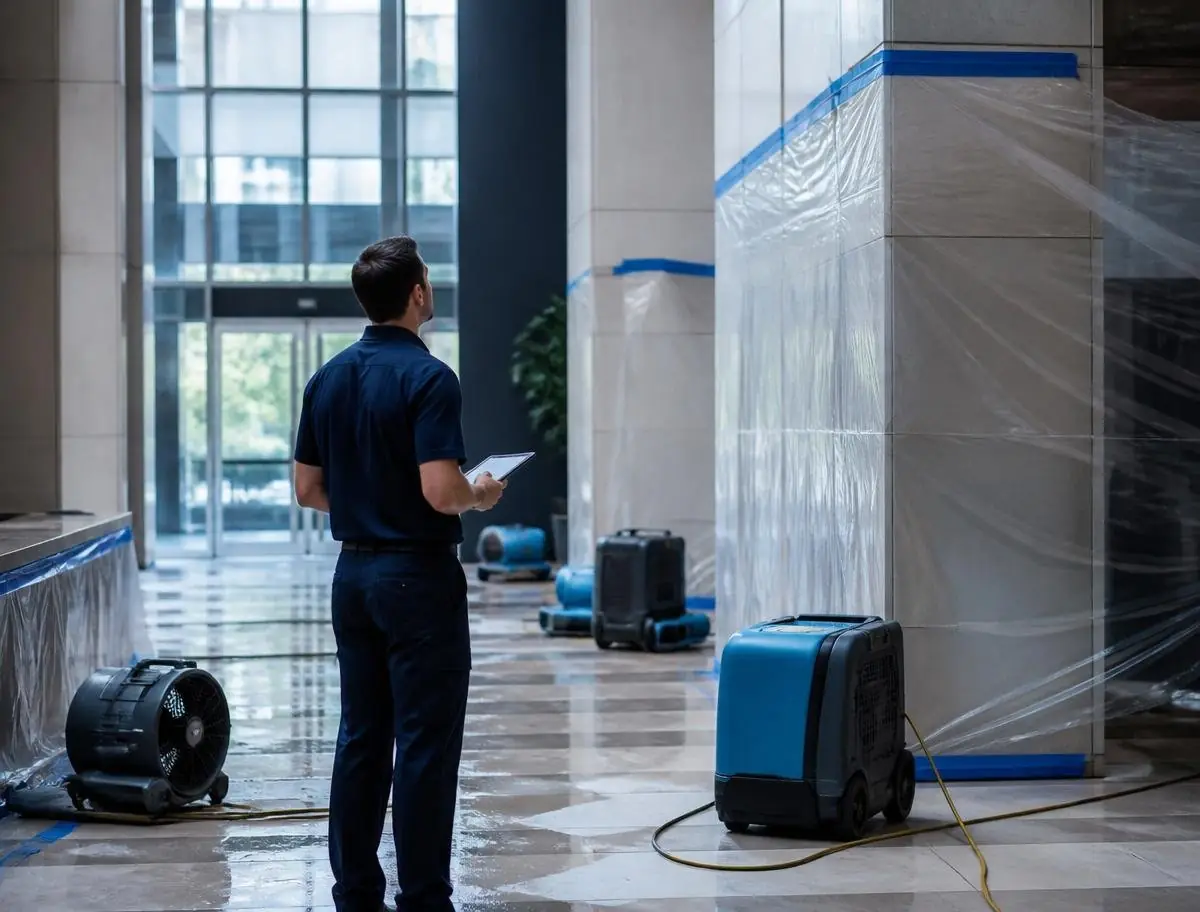
Restoration crews in high-rises have to follow building rules: check in at the desk, use the service elevator, protect hallways and elevator cabs, work within set hours, and provide a certificate of insurance. Portable extractors replace truck-mounted units when there is no truck access. Tell the operator your building name and any rules you know about, and the provider can send insurance certificates to management ahead of time.
Many Uptown and Downtown buildings have concrete floors under hardwood, tile or engineered flooring. Concrete holds water for a long time, so drying the slab is often the longest part of the job. See water mitigation and structural drying.
Deep Ellum and the August 2022 flood
Deep Ellum was one of the neighborhoods flooded in the August 21 to 22, 2022 storm, when Dallas set a provisional record of 3.01 inches of rain in one hour. Ground-floor bars, music venues, shops and lofts took water from the street. Street-level flood water is Category 3 and is cleaned up differently from a clean-water leak. See flood damage restoration.
Older buildings in the West End and Downtown
The West End and parts of Downtown have converted warehouse and early 20th-century buildings, many now lofts and offices. Brick, heavy timber and old plaster absorb water and dry slowly. Old cast-iron drain stacks and roof drains are common sources of leaks. These jobs are usually Class 4 drying with careful monitoring.
Mold in condos and apartments
Closed-up units, leaks behind kitchen cabinets and condensation around in-unit HVAC equipment all grow mold. In Texas, residential buildings with 10 or more units have specific licensing rules for larger mold jobs. See mold remediation in Dallas.
Baylor and Bryan Place, Oak Lawn and Turtle Creek
Around Baylor University Medical Center in 75246 and the Bryan Place townhomes, and along Turtle Creek and Oak Lawn in 75219, the mix runs from 1980s townhomes to older mid-rise condos and new luxury towers. Older buildings see more pipe and stack failures; new ones see more appliance, sprinkler and installation leaks.
Getting help in Uptown and Downtown
Call (972) 544-0840. Tell the operator your building name or address, floor and unit, and whether water is still coming from above. Landmarks help too: near Klyde Warren Park, along McKinney Avenue, in the Arts District, near Reunion Tower or the West End. You will be connected with an independent restoration company that works in Dallas high-rises.
Nearby areas we cover: Oak Cliff across the Trinity, East Dallas past Deep Ellum, and Preston Hollow to the north.