
Find the source before you fix the surface
A water stain on a ceiling or wall is a symptom. Patch and paint it without fixing the source and drying what is behind it, and the stain comes back, usually with mold. In Dallas the usual sources are:
- Roof leaks after hail and wind, or from worn flashing around chimneys, vents and skylights
- Attic AC condensate overflows in summer, when an air handler runs nearly nonstop and the drain line clogs
- Attic water heaters leaking from the tank or a missing or clogged drain pan
- Second-floor bathrooms and laundry: failed wax rings, shower pans, supply lines and washer hoses
- Frozen and burst attic lines in winter cold snaps; see burst pipes and leaks
- Exterior wall leaks around windows and doors in wind-driven rain
A good inspection traces the path with moisture meters and a thermal camera, then confirms the leak is fixed before repairs begin.
Ceiling water damage repair
Signs the ceiling is in trouble
- Yellow or brown rings that grow
- Paint bubbling, peeling or forming a blister
- A soft spot, sag or bulge
- Drips from a light fixture, vent or smoke detector
- A musty smell in one room
How ceilings get repaired
If the drywall is still firm and the water was clean, it can often be dried in place with air movers and dehumidifiers, after the wet attic insulation above it is pulled or dried. If it sagged, crumbled or soaked from a dirty source, that section is cut out, the joists are dried, and new drywall is hung, taped, textured and painted to match. Matching ceiling texture is a skill; ask how the provider handles it.
Wall and drywall water damage repair
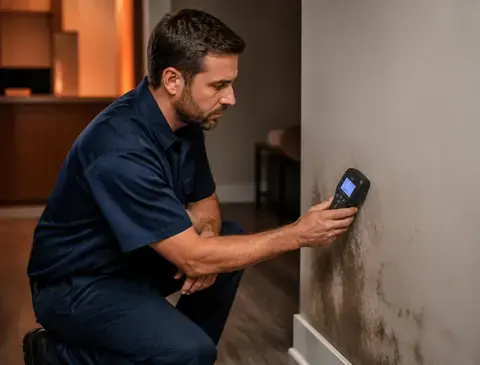
Drywall wicks water up from the floor like a paper towel. The visible water line is not where the moisture stops. Meters tell the crew how high it went.
The choices for a wet wall:
- Dry in place. For clean water caught early, with no swelling. Baseboards come off, and small holes behind the baseboard let air into the cavity.
- Flood cut. A straight cut, usually 2 or 4 feet above the floor, to remove wet drywall and insulation and open the cavity. Standard for floodwater, sewage and insulated exterior walls that got soaked. It looks rough, but it is often cheaper and faster than fighting a wet wall for a week.
- Full replacement. When water came from above and ran down the whole wall, or mold is present.
Older homes in East Dallas and Oak Cliff may have plaster on wood lath instead of drywall. Plaster is dense and slow to dry, but it can often be saved, which is worth it in a historic house.
Hardwood floor water damage restoration
Wood absorbs water and swells across the grain. That shows up in three ways:
| What you see | What it means | Usual outcome |
|---|---|---|
| Cupping: board edges higher than the center | More moisture below the board than above | Often recovers with prompt specialty drying |
| Crowning: center higher than edges | Often from sanding a cupped floor too early | Usually needs refinishing or replacement |
| Buckling: boards lifting off the subfloor | Severe, prolonged saturation | Usually replacement of the affected area |
Hardwood is Class 4 drying under the IICRC standard. Crews use floor drying mats or panels that pull moisture up through the wood, plus low-humidity dehumidification. Do not sand or refinish until moisture readings match unaffected wood in the same house, which can take weeks. On pier-and-beam homes, the crawl space under the floor has to be dried too. Engineered wood and laminate are less forgiving; laminate that swelled at the seams is usually replaced.
Carpet and pad drying is covered on the water extraction and removal page.
Roof leak water damage after Dallas storms
Texas led the country in major hail events again in 2025, with 902, according to NICB citing the Insurance Information Institute. In North Texas, spring hail and straight-line winds crack shingles, punch through skylights and tear flashing, and the next rain finds the opening.
What to do after a storm leak:
- Get a temporary tarp on the roof. Keep the receipt; temporary repairs to prevent more damage are expected under Texas policies.
- Put buckets under drips and move belongings.
- Photograph the ceiling, the attic if safe, and any visible roof damage from the ground.
- Get the attic insulation and ceiling checked for moisture. Wet blown-in insulation flattens and keeps the drywall below it wet.
Most North Texas policies now carry a separate wind and hail deductible, commonly 2% of dwelling coverage. Check yours before you assume the claim is worth filing. And remember that no Texas contractor is allowed to waive or absorb your deductible.
Why drying comes before rebuilding
Closing up a wall or ceiling that is still wet traps moisture against the framing and new drywall. That is how a $2,000 leak becomes a mold job. Drying is covered on our water mitigation page, and mold rules on the mold remediation page. The full sequence, from first call to final paint, is on the Dallas water damage restoration home page.