
Mold after water damage: how fast it happens in Dallas
Mold needs moisture, food and warmth. A wet Dallas house supplies all three. Drywall paper, wood, carpet backing and dust are food. Our climate supplies the warmth. The Texas Department of Insurance warns that mold can start growing within a day of a leak, and in a closed-up home in July, visible growth on wet drywall in two to three days is common.
That is why the best mold remediation is the one you never need. Fast water mitigation and drying after a leak prevents most mold jobs.
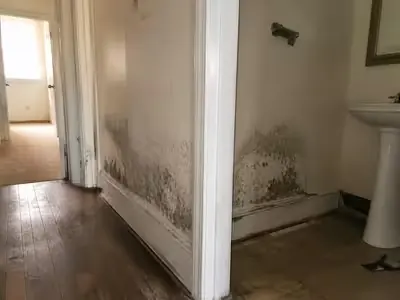
Where Dallas homes grow mold
- Behind baseboards and under flooring after a leak that was mopped up but never dried.
- Attics, on roof decking and rafters, from roof leaks, bath fans venting into the attic, and condensation around AC ducts and air handlers.
- Around AC air handlers, drain pans and supply registers, where cold ducts sweat in humid summer air.
- Bathrooms: shower walls, behind toilets and under vanities with slow leaks.
- Crawl spaces under older pier-and-beam homes, on joists and the underside of the subfloor.
- Ceilings and drywall below upstairs bathrooms and attic units.
- Closed-up vacant homes and rentals where the AC was shut off over the summer.
Texas mold rules every Dallas homeowner should know
Texas licenses mold work through the Texas Department of Licensing and Regulation (TDLR). The rules are stricter than in most states, and they protect you.
- Two separate licenses. A Mold Assessment Consultant inspects, writes the remediation protocol and confirms clearance. A Mold Remediation Contractor does the removal.
- Not the same company on the same job. A person or company may hold both licenses, but cannot do the assessment and the remediation on the same project. This keeps the company that profits from removal from also defining how much removal you need.
- The 25 square foot line. Per TDLR, visible mold covering 25 contiguous square feet or more in residential properties with 10 or more units must be handled by licensed professionals. Houses and smaller buildings have certain exemptions, but a licensed remediator must follow the rules on any size job.
- Certificate of Mold Damage Remediation. After a licensed job passes clearance, you get a CMDR. Insurers and future buyers may ask for it, and only a licensed remediator can issue one.
When you call (972) 544-0840 about mold, we connect you with a Texas-licensed remediation company. If you need an assessment, ask for it, and you will be pointed to a separately licensed consultant. Before work starts, ask each company for its TDLR license number and check it on the TDLR website.
Mold inspection, testing and assessment: when are they worth it?
If you can see the mold and you know the leak that caused it, testing usually does not change the plan. The mold comes out either way. Testing earns its cost when:
- You smell mold but cannot find it
- Someone in the house has health symptoms and you want to know what you are dealing with
- A landlord, tenant, buyer or insurer requires documentation
- The job is large enough that Texas rules require an assessment protocol
- You want independent clearance testing after remediation
Assessment can include visual inspection, moisture readings, air samples compared with an outdoor baseline, and surface samples sent to a lab.
How mold remediation is done
- Fix the water. No remediation lasts if the leak, condensation or drainage problem remains.
- Containment. Plastic barriers and negative air pressure with HEPA filtration keep spores from spreading during removal.
- Removal. Mold-damaged porous materials such as drywall, insulation, carpet and ceiling tiles are cut out and bagged inside containment.
- Cleaning. Framing and hard surfaces are HEPA-vacuumed and cleaned. Light growth on wood can be cleaned; heavy growth may be sanded or the wood replaced.
- Drying to normal moisture levels.
- Clearance. On licensed projects, the assessment consultant verifies the work before containment comes down.
- Rebuild with new materials.
The industry standard for this work is IICRC S520. Good remediation is mostly careful removal and cleaning, not spraying chemicals on top of growth.
Black mold, bleach and other myths
- "Black mold" is not a diagnosis. Many molds look dark. Color does not tell you the species or the risk. Treat any significant indoor growth seriously.
- Bleach does not fix drywall mold. It may lighten the stain but adds water and does not reach growth inside porous material.
- Painting over mold hides it for a while. It keeps growing behind the paint.
- Ozone and foggers alone do not remove mold. Removal and cleaning do.
HVAC and air duct mold
Dallas AC systems remove a lot of moisture from the air, and that water has to go somewhere. Mold around the air handler, evaporator coil, drain pan and supply registers is common. Duct cleaning or coil cleaning should be done by a qualified HVAC or remediation company, and the cause, such as oversized equipment, leaky ducts in a hot attic or a clogged drain, should be fixed at the same time.
Does insurance pay for mold in Texas?
If the mold grew from a covered, sudden water loss, the damaged items are usually covered. Mold from a long-term leak or from flood water usually is not, and many policies limit mold cleanup and testing. TDI recommends using a state-licensed mold professional and keeping the certificate of mold removal for your records.
Preventing mold after any leak
- Get wet materials drying within 24 to 48 hours.
- Keep indoor humidity reasonable; run the AC and bathroom fans.
- Clear AC condensate lines each spring and check drain pans.
- Fix slow leaks under sinks and around toilets as soon as you see them.
- Vent bath fans outdoors, not into the attic.
For the full picture of what happens after water gets into a Dallas home, from extraction to rebuild, see our guide to emergency water damage restoration in Dallas. For mold behind ceilings and walls after a roof or plumbing leak, see ceiling, wall and floor water damage repair.