
Shut the water off first
Before you call anyone, stop the water at the main valve. In most Dallas homes it is a round handle or lever where the supply line comes into the house: near the front hose bib, in the garage, or close to the water heater. If you cannot find it or it will not turn, the city meter box near the curb has a valve too, though it may take a meter key.
- Toilet: turn the oval handle behind it clockwise.
- Washer, dishwasher, fridge or ice maker: close the valve on the supply line behind the appliance.
- Water heater: close the cold-water valve on top of the tank and turn off the gas or power to it.
- Water bubbling up in the yard or street: that may be a city main. Report it to Dallas 311 and pick "water main leak/break."
Once the water is off, call a plumber for the pipe and (972) 544-0840 for the water damage. They are different jobs.
Why pipes burst in Dallas
Dallas pipes fail for different reasons in different seasons.
Winter: fast freezes and attic plumbing
Dallas sees freezing temperatures on roughly 23 nights a year. That is not many, and that is the problem: houses here are built for heat. Supply lines, water heaters and AC drain lines often sit in unheated attics, and hose bibs and laundry lines sit on exterior walls. When a front drops temperatures 40 degrees in an afternoon, attic lines freeze first, then lines in exterior walls and garages. Restorers in the area commonly see attic lines fail when attic temperatures fall to around 30°F. In February 2021, Winter Storm Uri pushed DFW below zero and burst pipes across the city.
The break often does not leak until the ice thaws. A lot of burst pipe calls come the morning the weather warms up.
Summer: heat, demand and moving soil
In summer 2026, Dallas Water Utilities repaired 310 main breaks and leaks plus 377 service line leaks in three months, as daily use topped 600 million gallons and dry clay soil shifted pipes, according to the City of Dallas. The same soil movement stresses the lines under your slab.
Any time: age and material
The median Dallas home was built around 1980. That puts many houses in the era of galvanized steel and cast-iron drains (older homes) or polybutylene supply pipe (roughly late 1970s to mid-1990s). Each fails in its own way: galvanized rusts from the inside, cast iron cracks and scales, and polybutylene tends to fail at fittings.
Slab leak water damage
A slab leak is a leak in a water or drain line running under or inside your concrete foundation. In Dallas, expansive clay soil moves the slab a little every wet and dry season, and that movement stresses buried pipes.
Signs of a slab leak:
- A warm spot on tile or wood floor (hot-water line)
- The sound of running water with every fixture off
- A water bill that jumps without explanation, or the meter moving with everything off
- Damp or musty carpet with no visible source
- Swollen baseboards, cracked tile, or new cracks in floors and walls
A plumber locates and repairs the leak, by tunneling, breaking out a section of slab, or rerouting the line. The restoration side dries the slab and whatever flooring and walls sat on top of it. Slab leaks are common in mid-century neighborhoods like Lake Highlands.
Appliance leak cleanup
Appliances cause a large share of indoor water calls. The usual suspects:
| Appliance | Typical failure | Where the water goes |
|---|---|---|
| Water heater | Tank rusts through or relief valve discharges | Garage floor, closet, or through the ceiling if it is in the attic |
| Washing machine | Rubber supply hose bursts | Laundry room, hall, under adjoining walls |
| Refrigerator / ice maker | Plastic supply line cracks | Under kitchen cabinets and hardwood |
| Dishwasher | Drain or supply leak, door seal failure | Under the cabinet and subfloor, often unseen for weeks |
| AC air handler | Clogged condensate line, rusted drain pan | Ceiling below the attic unit |
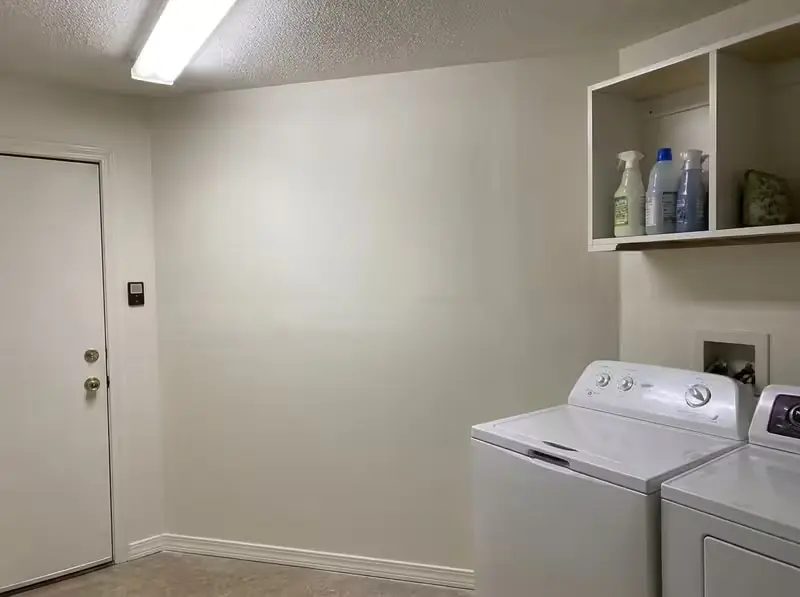
Swap rubber washer hoses for braided stainless lines, and replace them every five years or so. Put a drain pan with a working drain under any water heater above a living space. Both are cheap compared with a ceiling.
Toilet overflow cleanup
How a toilet overflow gets cleaned depends on where the water came from. Water from a broken supply line or tank is clean. Water from the bowl is gray water at least. If waste was in the bowl or a drain line backed up, it is Category 3, and the cleanup follows the sewage backup cleanup process, including removing carpet and pad.
Second-floor toilet overflows often show up as a stain or drip on the ceiling below. That ceiling needs to be checked for wet insulation and drywall, even if the stain is small.
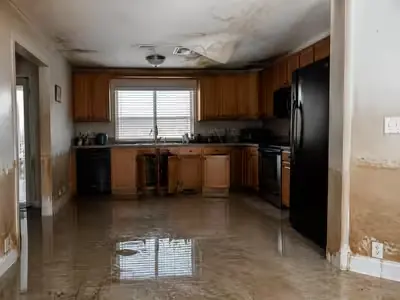 Before
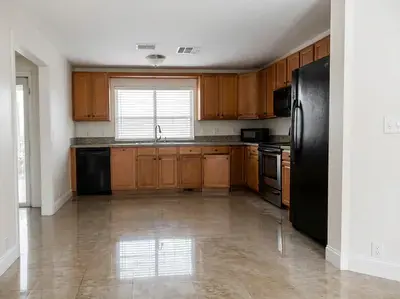 After
Representative images: a kitchen ceiling that let go under water from above, and the same type of kitchen after drying and repair. Not a specific Dallas job.
Is burst pipe damage covered by insurance in Texas?
Usually, if it was sudden and accidental. The Texas Department of Insurance lists a burst pipe as a typical covered water loss. Damage from a slow leak that went on for weeks usually is not. The pipe repair itself may or may not be covered depending on the policy form. Take photos of the broken pipe before the plumber throws it away; adjusters ask for it.
For the drying side of the job, see water mitigation and structural drying. For the bigger picture, our guide to water damage restoration in Dallas, TX covers costs, insurance and the full process.
Freeze prep checklist for the next Dallas cold snap
- Know where the main shut-off is and make sure it turns.
- Disconnect garden hoses and cover hose bibs.
- Open sink cabinets on exterior walls and let faucets drip.
- Insulate attic supply lines and add pipe insulation in the garage.
- Keep the thermostat steady overnight, even if you are away.
- If you will be gone, shut off the main and drain the lines.